





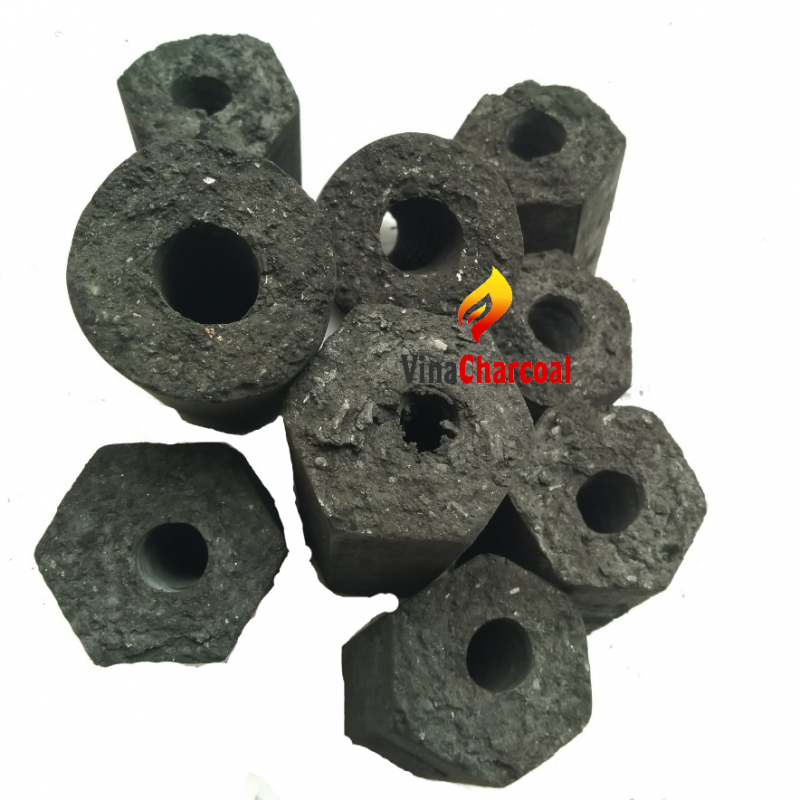
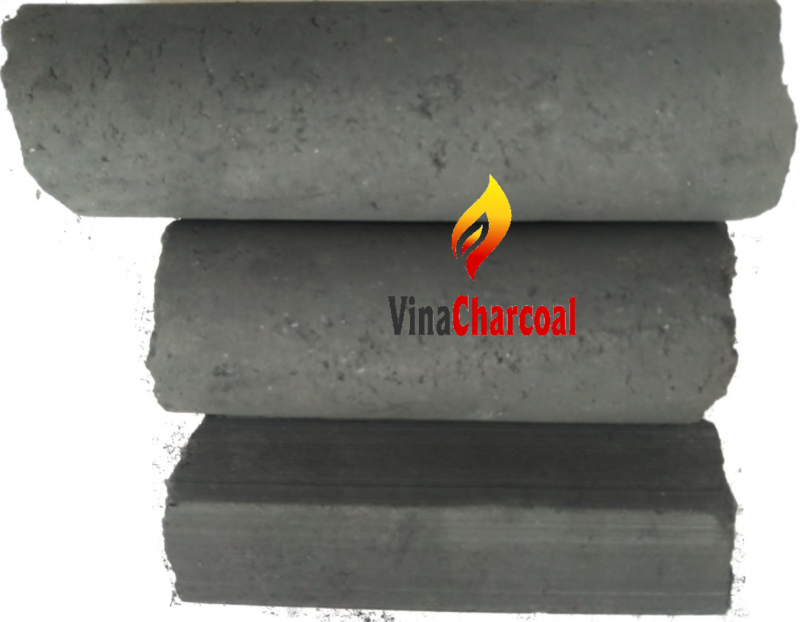
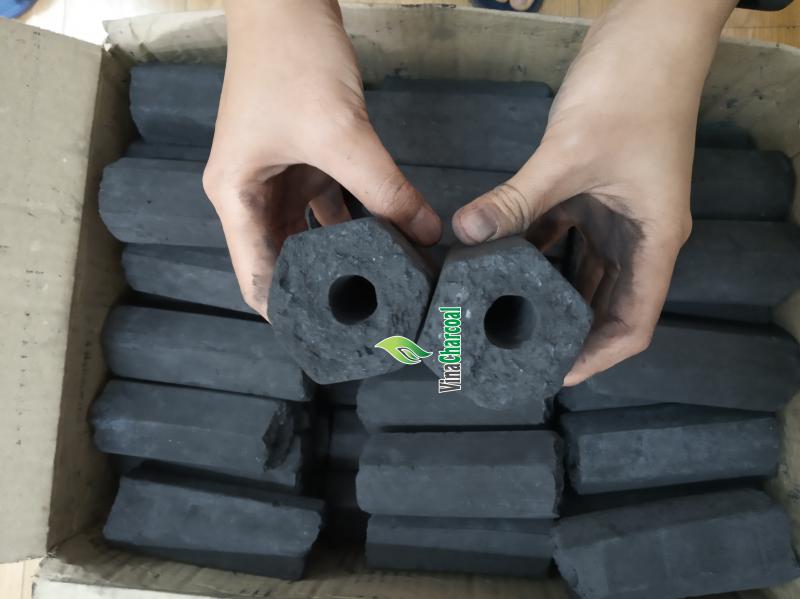
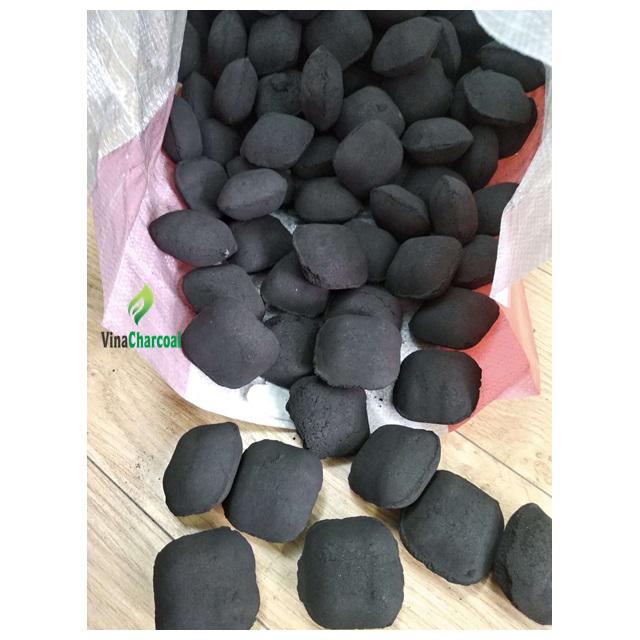
Wood Pellet (For Household Use) – Standard Grade
CONTACT US
- Commercial Name: Residential Wood Pellet – Standard Grade
- Product Code: BF-01
- Origin: Vietnam
Product Features
Wood Pellet is a clean biomass fuel produced from renewable sawdust and wood-processing by-products, providing an environmentally friendly energy solution for heating, cooking, and outdoor living applications. The product is manufactured from 100% natural wood materials without the use of chemicals or artificial binders.
Thanks to its dense structure, low moisture content, and consistent quality, wood pellets deliver stable combustion, easy storage, low dust generation, and convenient handling during transportation and use. Compared with traditional firewood, wood pellets offer better fuel control, more consistent heat output, and a cleaner user experience.
Wood Pellets are widely used in residential pellet stoves, pellet heaters, pizza ovens, BBQ smoking applications, camping, outdoor cooking, fire pits, and other household applications that prioritize clean and renewable biomass fuel.
Shape Cylindrical Pellet
Diameter 6 – 8 mm
Length 10 – 40 mm
Moisture Content < 8%
Ash Content < 3%
Calorific Value 4,300 – 4,600 kcal/kg
Mechanical Durability > 95%
Chlorine (Cl) < 0.03%
Sulfur (S) < 0.05%
Nitrogen (N) < 0.40%
Quality Characteristics
- Hard and durable pellets with minimal breakage
- Natural light brown to dark brown color
- Free from chemical additives
- Low dust content
- Stable and consistent burning performance
- Natural wood smoke aroma
- PE Bags: 5–20 kg
- PP/BOPP Bags: 5–20 kg
- Kraft Bags: 5–10 kg
- Carton Boxes: 5–15 kg
- Jumbo Bags: 500–1000 kg
- Packaging design
- Private label printing
- Customized packaging solutions
- Heating pellet brand development support
- Supply Capacity: 500 MT/month
- MOQ: 1 × 40HC
- Container Loading Capacity:
- Approximately 19 MT / 20DC
- Approximately 25 MT / 40HC
- Payment Terms: TT (30% deposit) or L/C at sight
- Delivery Time: Approximately 15 days
- Loading Port: Hai Phong Port or Ho Chi Minh Port
Australia, the United Kingdom, New Zealand, Europe, and other markets seeking clean residential biomass fuel for home heating, cooking, and outdoor lifestyle applications.
Vietnam is currently one of Asia’s leading wood processing and manufacturing countries. In recent years, the export value of wood and wood products has consistently reached approximately USD 14–16 billion annually, making Vietnam one of the world’s major centers for wood product manufacturing and export. Alongside this development, millions of tons of wood by-products such as sawdust, wood shavings, planer residues, and wood offcuts are generated every year from furniture factories, plywood mills, pallet manufacturers, woodchip processors, and other wood-processing facilities.
In addition to its strong wood-processing sector, Vietnam also possesses more than 4 million hectares of plantation forests, with Acacia and Eucalyptus representing the dominant species. These plantation forests are mainly concentrated in the Northern Midlands and Mountains, North Central Vietnam, Central Coastal regions, Central Highlands, and parts of Southeast Vietnam. They provide a stable and sustainable biomass resource base for the production of wood pellets, woodchips, and other renewable energy products.
Over the past decade, Vietnam’s wood pellet industry has expanded rapidly, driven by strong demand from Japan, South Korea, and Europe for biomass fuel used in power generation and industrial applications. Today, Vietnam is among the world’s largest wood pellet exporters, supplying millions of tons annually to international markets. This growth has resulted in the development of a well-established network of pellet manufacturing facilities, raw material collection systems, and biomass processing technologies throughout the country.
However, most wood pellets currently produced in Vietnam are intended for large-scale industrial applications such as biomass power plants and industrial boilers. In contrast, THALOCA focuses on developing wood pellets specifically for residential and household use, emphasizing cleanliness, stable combustion performance, low dust generation, convenient storage, and packaging formats suitable for everyday household applications.
After collection, the raw materials undergo thorough screening to remove impurities such as soil, stones, metal fragments, plastic particles, and other unsuitable materials. The sawdust, typically with a uniform particle size of less than 1 mm, is then dried and compressed under high pressure to form dense pellets. Thanks to the natural lignin contained in the wood, the pellets bond together firmly without the use of any chemicals or artificial binders.
By transforming renewable wood residues into a clean biomass fuel, wood pellet production not only increases the value of wood-processing by-products but also helps reduce biomass waste, supports circular economy practices, and provides an environmentally friendly energy solution for modern residential heating, cooking, and household applications.
- PE Bags: 5–20 kg
- PP/BOPP Bags: 5–20 kg
- Kraft Bags: 5–10 kg
- Carton Boxes: 5–15 kg
- Jumbo Bags: 500–1000 kg
- Packaging design
- Private label printing
- Customized packaging solutions
- Heating pellet brand development support
- Supply Capacity: 500 MT/month
- MOQ: 1 × 40HC
- Container Loading Capacity:
- Approximately 19 MT / 20DC
- Approximately 25 MT / 40HC
- Payment Terms: TT (30% deposit) or L/C at sight
- Delivery Time: Approximately 15 days
- Loading Port: Hai Phong Port or Ho Chi Minh Port
Australia, the United Kingdom, New Zealand, Europe, and other markets seeking clean residential biomass fuel for home heating, cooking, and outdoor lifestyle applications.
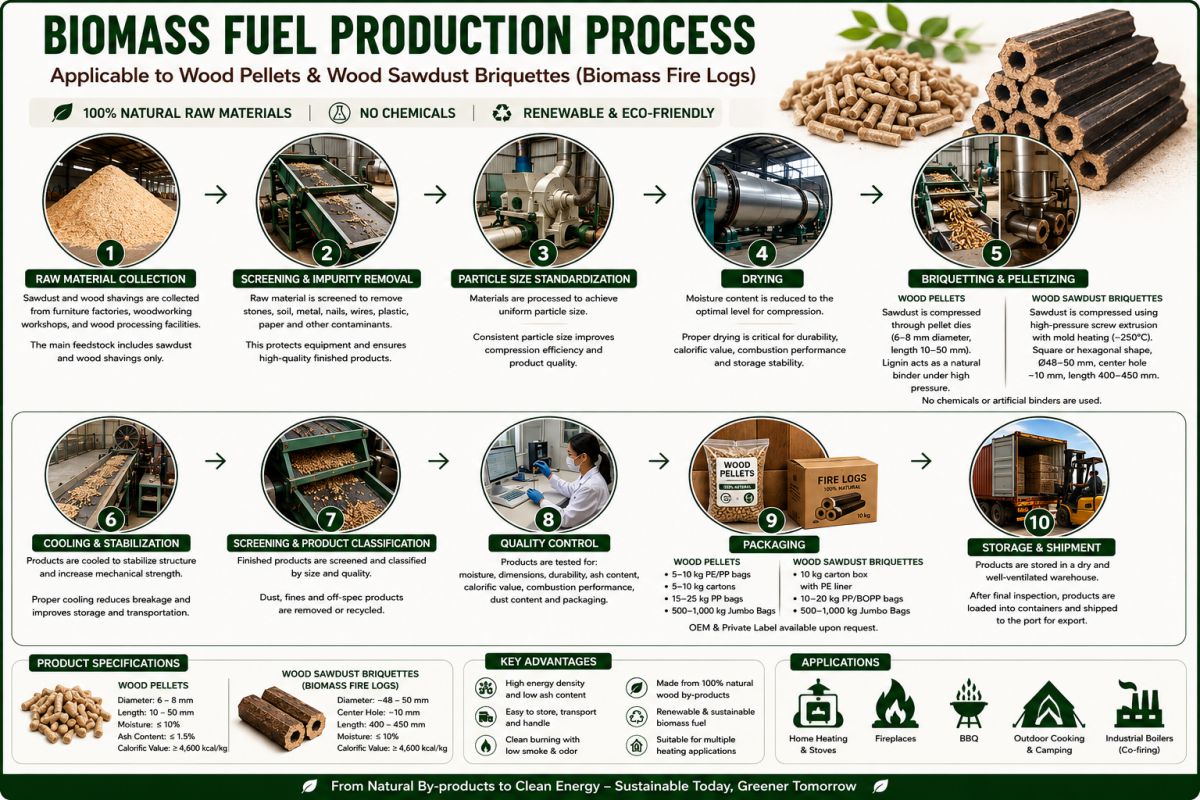
Applicable to Wood Pellets & Wood Sawdust Briquettes (Biomass Fire Logs)
Overview
Wood-based biomass fuel products are manufactured from sawdust and wood shavings collected from furniture factories, woodworking workshops, and wood processing facilities.
The two most common products are:
- Wood Pellets
- Wood Sawdust Briquettes (Biomass Fire Logs)
From a technical perspective, both products share a production process similar to the briquetting stage used in the manufacture of sawdust charcoal. Raw materials are screened, cleaned, dried, and compressed under high pressure to create dense biomass fuel products.
During the compression process, natural lignin contained in the wood acts as a natural binder, allowing the particles to bond together without the use of chemicals or artificial binding agents.
The main difference lies in the pressing equipment and mold design. Wood pellets are produced using pellet mills equipped with ring-die or flat-die systems, typically without direct mold heating. In contrast, wood sawdust briquettes are manufactured using high-pressure screw extrusion technology combined with heated molds operating at approximately 250°C, resulting in larger and denser fuel logs.
Step 1. Raw Material Collection
Raw materials are collected from furniture factories, woodworking workshops, pallet manufacturers, and other wood processing facilities.
The primary feedstock consists of sawdust and wood shavings generated during wood processing operations.
Step 2. Screening & Impurity Removal
The raw material is screened to remove stones, soil, metal fragments, nails, wires, plastic, paper, and other unsuitable materials.
This process helps protect production equipment and improves the quality of the finished products.
Step 3. Particle Size Standardization
The material is processed to achieve a uniform particle size before entering the drying and compression stages.
Consistent particle size improves compression efficiency and enhances product quality.
Step 4. Drying
The material is dried to reduce moisture content to a suitable level for compression.
Moisture content is one of the most critical factors affecting mechanical durability, combustion performance, ash content, storage stability, and overall product quality.
Step 5. Briquetting & Pelletizing
The dried material is fed into compression equipment to form the final products.
Wood Pellets
Sawdust is compressed through pellet dies using high-capacity pellet mills.
Under high pressure, natural lignin within the wood softens and acts as a natural binder, producing dense pellets with a typical diameter of 6–8 mm and lengths ranging from approximately 10–50 mm.
Wood Sawdust Briquettes
Sawdust is compressed using high-pressure screw extrusion systems combined with mold heating at approximately 250°C.
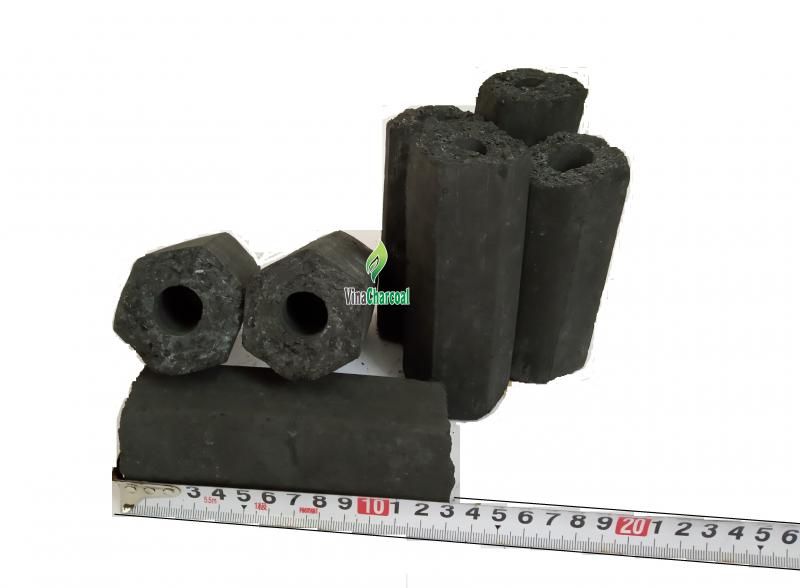
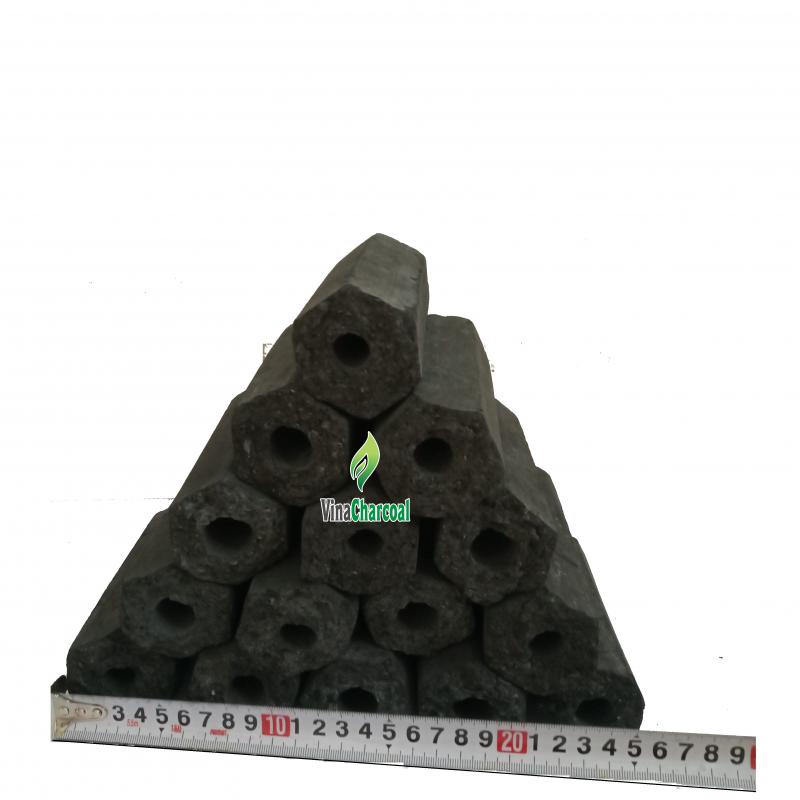
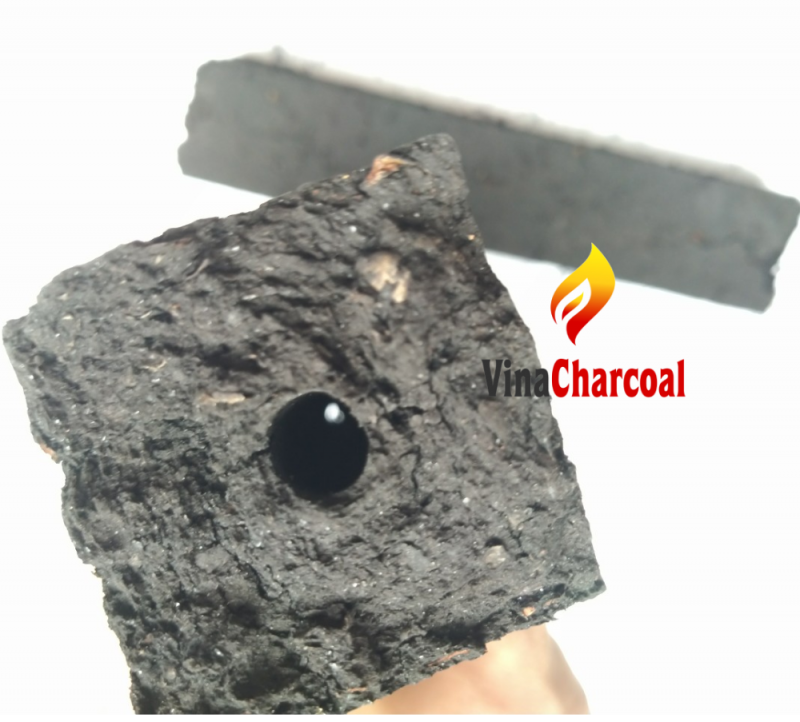
The finished product is typically produced in square or hexagonal shapes with an outer diameter of approximately 48–50 mm, a center hole of approximately 10 mm, and a length of approximately 400–450 mm.
Neither product uses chemicals or artificial binders.
Step 6. Cooling & Stabilization
After compression, the products are cooled to stabilize their internal structure and improve mechanical strength.
Proper cooling helps reduce breakage and improves storage and transportation performance.
Step 7. Screening & Product Classification
Finished products are screened and classified according to size, shape, and quality requirements.
Dust, fines, and off-specification products are removed or recycled back into the production process.
Step 8. Quality Control
Typical inspection criteria include:
• Moisture Content
• Dimensions
• Mechanical Durability
• Ash Content
• Calorific Value
• Combustion Performance
• Dust and Fine Content
• Packaging Specifications
Step 9. Packaging
Wood Pellets
Common packaging options include:
• 5–10 kg PE/PP bags
• 5–10 kg retail cartons
• 15–25 kg PP bags
• 500–1,000 kg Jumbo Bags
Wood Sawdust Briquettes
Common packaging options include:
• 10 kg carton boxes with moisture-protection PE liner
• 10–20 kg PP/BOPP bags
• 500–1,000 kg Jumbo Bags
OEM and Private Label packaging solutions are available upon request.
Step 10. Storage & Shipment
Finished products are stored in dry and well-ventilated warehouses to minimize moisture absorption and maintain stable quality.
After final inspection, the products are loaded into containers and delivered to the port for export according to the agreed international trade terms.
THALOCA’s production network is strategically located near key raw-material regions throughout Vietnam to optimize transportation costs and maintain a stable supply chain. Main production areas include Hung Yen, Yen Bai, Vinh Long, Can Tho, Binh Phuoc, and Ca Mau.
Yes. THALOCA welcomes customers, partners, and inspection agencies to visit our facilities. We encourage customers to evaluate our production capacity, quality control system, packaging process, and supply capability before establishing long-term cooperation.
THALOCA exports to Japan, South Korea, Australia, New Zealand, Saudi Arabia, UAE, Qatar, Kuwait, the United Kingdom, Russia, Spain, Turkey, the United States, and other international markets.
Yes. Free product samples are available for quality evaluation. International courier charges are usually borne by the customer or negotiated case by case.
THALOCA supplies five main product groups: Wood Charcoal, Sawdust Charcoal, Coconut Charcoal Products, Binchotan-Style White Charcoal, and Household Biomass Fuels such as Wood Pellets and Wood Sawdust Briquettes.
Each product has unique characteristics depending on its raw material and production technology. Wood charcoal is made from natural firewood. Sawdust charcoal offers high calorific value and long burning time. Coconut charcoal is ideal for BBQ and shisha applications. Binchotan is the premium category with high carbon content, almost no smoke, minimal odor, and exceptional burning performance.
Depending on the product and market requirements, THALOCA can provide technical specifications, laboratory test reports, FSC, SGS, Vinacontrol, and other certifications requested by customers.
Yes. We cooperate with SGS and other independent inspection organizations designated by customers during production, before packing, or before container loading.
Since 2008, THALOCA has been supplying charcoal and biomass fuel products to customers across Japan, South Korea, Australia, the Middle East, Europe, and many other international markets.
Over the years, we have received a wide range of questions regarding products, quality standards, OEM services, export documentation, payment terms, logistics, and ordering procedures. To help customers quickly find the information they need, we have compiled the most frequently asked questions below.
If you cannot find the answer you are looking for, please feel free to contact the THALOCA team. We are always ready to provide support and recommend the most suitable solution for your business needs.